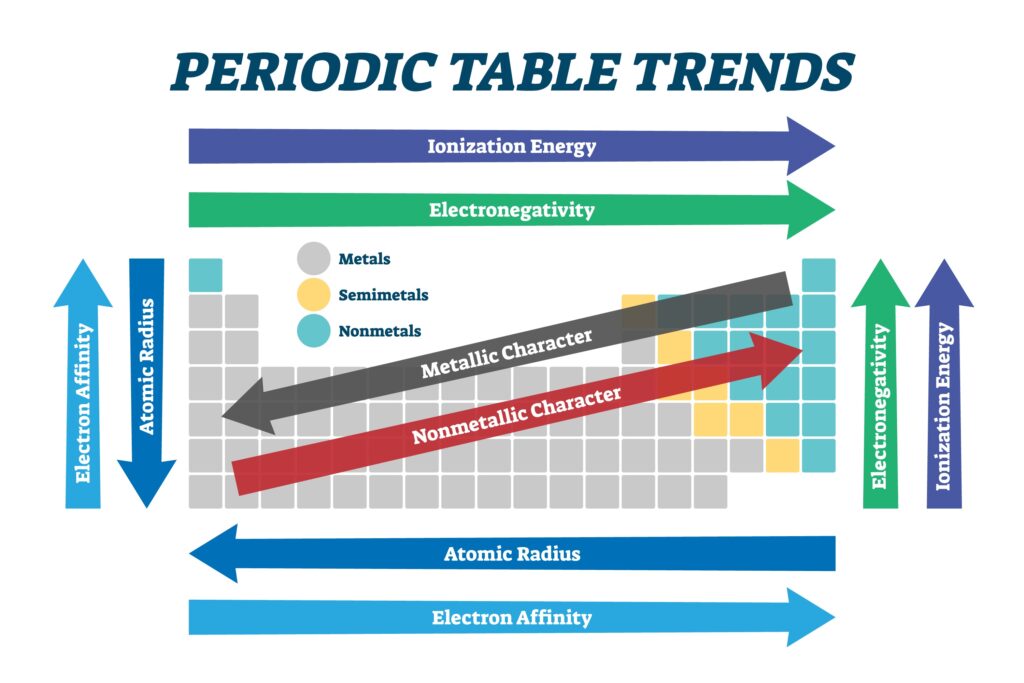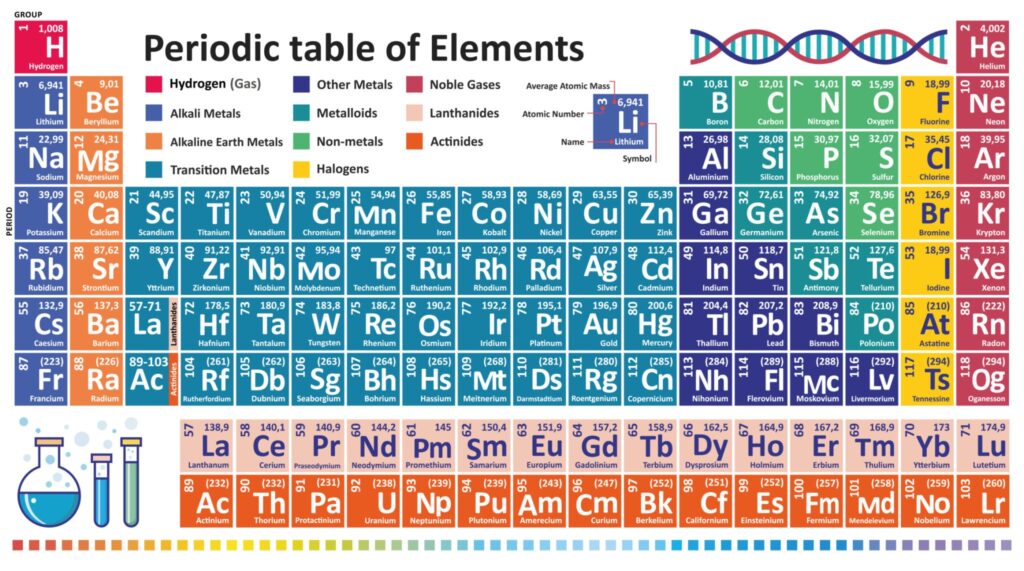
The shielding effect is the decrease in attraction between the nucleus and the valence electrons caused by the presence of inner (core) electrons.
- The Mechanism: Because electrons are negatively charged, they repel each other. Inner electrons sit between the nucleus and the valence electrons, essentially “blocking” or “screening” the positive charge of the nucleus.
- The Consequence: The valence electrons do not feel the full positive charge of the nucleus. Instead, they feel a reduced force called the Effective Nuclear Charge (Zeff)
Trends in the Periodic Table
1. Across a Period (Left to Right)
- Trend: Stays roughly constant.
- Explanation: When you move across a period, you are adding protons to the nucleus and electrons to the same principal energy level (the same shell). Since these new electrons are at the same distance from the nucleus as the previous ones, they do not provide additional “shielding” for each other.
- Result: Because shielding is constant while the nuclear charge increases, the pull on the valence electrons increases, causing the atomic radius to decrease.
2. Down a Group (Top to Bottom)
- Trend: Increases.
- Explanation: Each step down a group adds an entirely new energy level (shell). These extra shells place more layers of electrons between the nucleus and the valence electrons.
- Result: The “wall” of shielding becomes thicker and more effective. This reduces the nucleus’s hold on the outermost electrons, contributing to the increase in atomic radius as you go down a group.
Summary Table for Students
| Direction | Shielding Effect Change | Why? |
| Across a Period | Constant | Electrons are added to the same energy level |
| Down a Group | Increases | More inner energy levels are added |
Why This Matters (The “So What?”)
Understanding shielding is the “master key” to predicting chemical behavior
- Ionization Energy: High shielding (down a group) means the nucleus has a weak grip on the outer electron, making it easier to remove (low ionization energy).
- Electronegativity: High shielding means the atom is less effective at pulling in new electrons, leading to lower electronegativity.
- Chemical Reactivity: In metals (like Group 1), high shielding at the bottom of the group makes them more reactive because they can “lose” their valence electron very easily.