
The modern periodic table is organized by atomic number. Understanding periodic trends allows us to predict the chemical and physical behavior of elements based on their position (Group or Period).
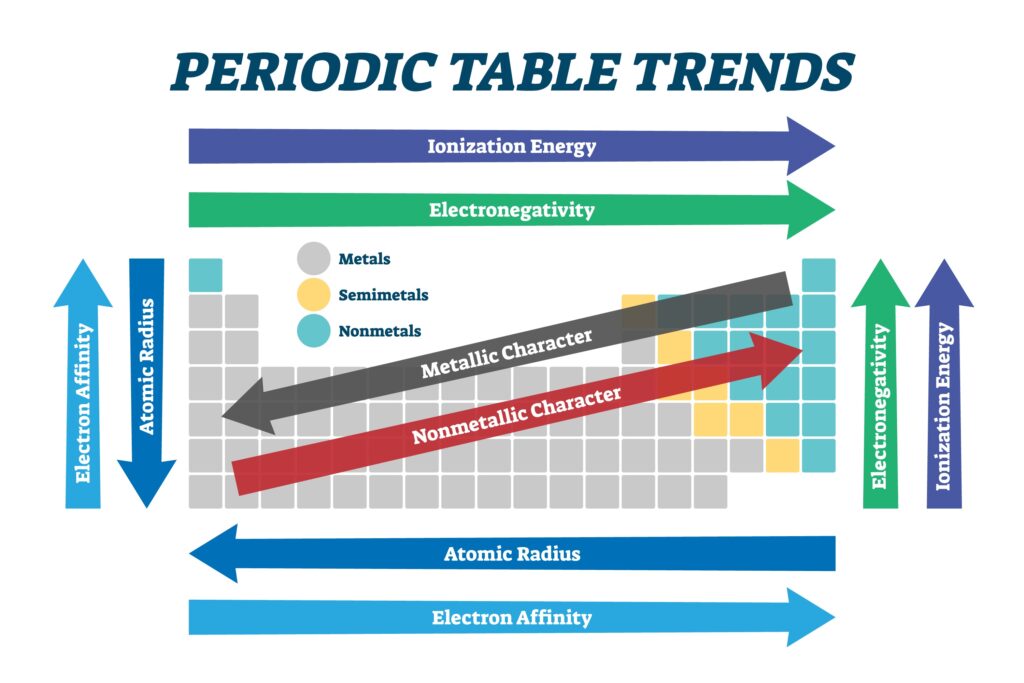
1. Key Trends Overview
| Property | Trend Across a Period (Left to Right) | Trend Down a Group (Top to Bottom) |
| Atomic Radius | Decreases | Increases |
| Ionization Energy | Increases | Decreases |
| Electronegativity | Increases | Decreases |
| Metallic Character | Decreases | Increases |
2. Deep Dive into Periodic Trends
Atomic Radius
Atomic radius is the distance from the center of the nucleus to the outermost electron shell.
- Across a Period: As you move left to right, the number of protons increases, creating a stronger nuclear pull on the electrons, which shrinks the atom.
- Down a Group: As you move down, new electron shells (energy levels) are added, increasing the distance between the nucleus and the valence electrons.
Ionization Energy (IE)
Ionization energy is the energy required to remove the outermost electron from a neutral atom in its gaseous state.
- Across a Period: Since the atomic radius decreases and the nuclear charge increases, electrons are held more tightly, making them harder to remove.
- Down a Group: Electrons are further from the nucleus (shielding effect) and are held less tightly, requiring less energy to remove.
Electronegativity
This is a measure of an atom’s ability to attract a shared pair of electrons in a chemical bond.
- Across a Period: Electronegativity increases because the nuclear charge increases, making the atom more effective at pulling in electrons.
- Down a Group: Electronegativity decreases because the valence shell is further away from the nucleus, weakening the pull on outside electrons.
Metallic Character
Metallic character refers to how easily an element loses electrons to form positive ions (cations).
- Across a Period: Metallic character decreases as elements move from being metals to non-metals.
- Down a Group: Metallic character increases because larger atoms lose their valence electrons more easily.
3. The “Why” Behind the Trends
These patterns are governed by two fundamental factors:
- Effective Nuclear Charge: The net positive charge experienced by valence electrons. A higher charge pulls the electron cloud tighter.
- Shielding Effect: Inner electron shells act as a “shield,” blocking the pull of the nucleus on the outer electrons. This effect increases as you move down a group.