
The Periodic Table did not appear overnight. It is the result of decades of scientific observation, pattern recognition, and chemical discovery. Below is the progression of the most significant models.
1. Döbereiner’s Triads (1817)
Johann Wolfgang Döbereiner noticed that groups of three elements (triads) showed similar chemical properties. He observed that the atomic mass of the middle element was approximately the average of the other two.
- Key Concept: Early attempt to group elements by mathematical relationships.
- Limitation: It did not apply to all known elements.
2. Newlands’ Law of Octaves (1864)
John Newlands arranged elements in order of increasing atomic mass and noted that every eighth element exhibited properties similar to the first, much like musical octaves.
- Key Concept: The concept of periodicity (repeating patterns).
- Limitation: It only worked well for elements up to Calcium and failed for heavier elements.
3. Mendeleev’s Periodic Table (1869)
Dmitri Mendeleev is considered the “Father of the Periodic Table.” He arranged elements by increasing atomic mass but, crucially, left gaps for elements that had not yet been discovered. He predicted the properties of these missing elements (like Gallium and Germanium) with astonishing accuracy.
- Key Concept: Periodic Law—the properties of elements are periodic functions of their atomic masses.
- Strength: Predictive power allowed the scientific community to accept his model.
4. Moseley’s Periodic Law (1913)
Henry Moseley used X-ray spectroscopy to determine the atomic number (number of protons) of elements. He discovered that atomic number is a more fundamental property than atomic mass. This resolved the anomalies in Mendeleev’s table (where some elements were in the wrong place based on mass).
- Key Concept: Modern Periodic Law—the properties of elements are periodic functions of their atomic numbers.
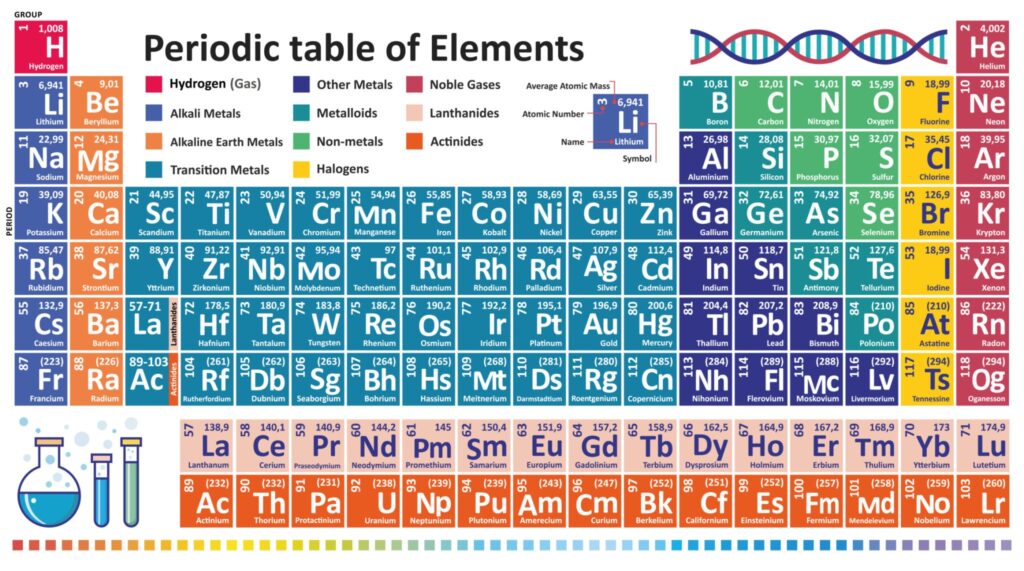
5. The Modern Periodic Table (Long Form)
The current table organizes elements by increasing atomic number. It is structured into:
- Periods: Horizontal rows (indicating the number of electron shells).that is with 7 periods
- Groups: Vertical columns (indicating the number of valence electrons and similar chemical reactivity). with 8 main and 8 subgroup.
Comparison Summary for Students
| Scientist | Basis of Arrangement | Key Contribution |
| Döbereiner | Atomic Mass (Triads) | Established grouping by properties. |
| Newlands | Atomic Mass (Octaves) | Introduced the concept of periodicity. |
| Mendeleev | Atomic Mass | Predicted undiscovered elements. |
| Moseley | Atomic Number | Corrected the arrangement flaw. |
how many elements in modern periodic table
| Periods | total elements |
| 1 | 2 |
| 2 | 8 |
| 3 | 8 |
| 4 | 18 |
| 5 | 18 |
| 6 | 32 |
| 7 | 32 |
total elements in modern periodic table
in modern periodic table 118 elements list .